
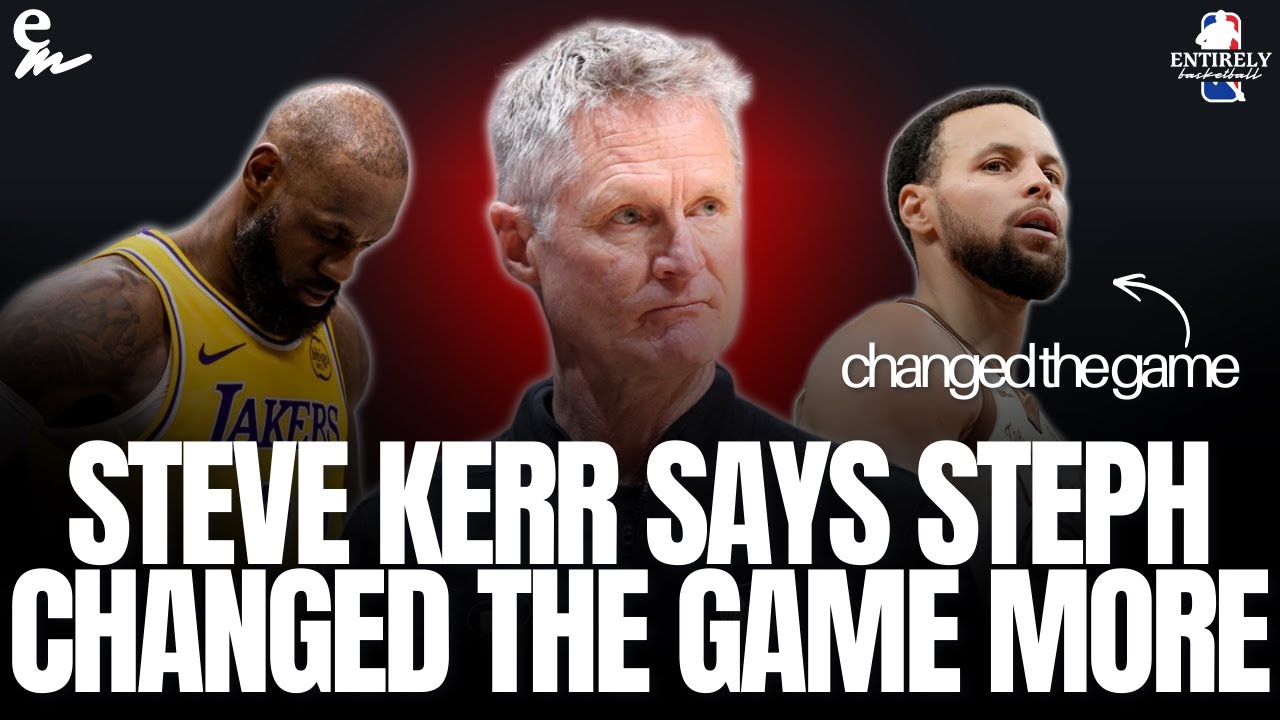
Welcome back to Entirely Media. In this high-octane session, the panel dives into Steve Kerr’s controversial claim that Steph Curry—not LeBron James—is the player who fundamentally changed the game of basketball. From the “gravitational pull” of the logo shot to the “player empowerment” era, we’re breaking down the legacies of the two biggest icons of the generation.
Watch the full replay to see the panel clash over whether Steph’s aesthetic impact outweighs LeBron’s fundamental shift in the league’s power balance.
I. The Steve Kerr Narrative: Steph vs. LeBron
Who changed the NBA more, Steph Curry or LeBron James? Most basketball analysts agree that while LeBron James redefined the “Point Forward” prototype and career longevity, Steph Curry fundamentally altered the game’s geometry by making the three-point shot the primary weapon for all five positions.
The Engine of Modern Offense
The friction on the panel was immediate. “Steve Kerr is spot on,” noted Chris Luchey, emphasizing that Steph made the game tangible for the average-sized player. However, Aaron Miller quickly countered, arguing that LeBron’s influence is “fundamental” while Steph’s is “aesthetic.”
- The Blueprint: Teams now hunt for “LeBron clones”—jumbo playmakers like Luka Doncic and Nikola Jokic.
- Key Takeaway: Steph changed how the game is played on the court, but LeBron changed how the league is run behind the scenes.
II. The “Gravitational Pull” of the Logo Shot
How does Steph Curry’s shooting affect NBA defenses? Steph Curry’s “gravity” refers to his ability to draw defenders away from the hoop to the half-court line, creating massive lanes for teammates to score. This defensive “pull” is widely considered the most significant tactical shift in the modern era.
The Draymond Effect
Darion Robinson and Murph pushed back on the idea that Steph’s impact is merely aesthetic. “His gravitational pull is crazy,” Darion argued. If you have to pick a player up at the logo, the entire defensive shell breaks. Murph added that this shift has essentially murdered the mid-range game in favor of the “live by the three” philosophy.
“The reason your team doesn’t look like the Warriors is because you don’t have Steph Curry. Stop trying to emulate the math without the genius.” — Aaron Miller
III. The AJ Dybantsa Dilemma: Stay or Go?
Will AJ Dybantsa stay in college for four years? As of 2026, top NBA prospects like AJ Dybantsa are weighing the immediate financial security of the NBA Draft against the massive NIL earnings and personal milestones, such as obtaining a college degree, available in the collegiate system.
NIL Leverage vs. The Super Max
The panel was divided on whether a potential #1 pick staying in college is a “legendary move” or a “300-million-dollar mistake.” Ashley Chevalier argued that it could change the “one-and-done” culture, making college a place for true development again.
- The Financial Risk: Staying at BYU means delaying a rookie max extension that could be worth upwards of $300M.
- Internal Link: Learn more about the latest Entirely NBA draft boards and player rankings.
IV. The Minnesota Timberwolves’ Internal Friction
Is Rudy Gobert taking shots at Anthony Edwards? Recent comments from Rudy Gobert regarding the need for “players who pass the ball” have sparked rumors of tension between the defensive anchor and superstars Anthony Edwards and Julius Randle.
Accountability vs. Discipline
Aaron Miller didn’t hold back: “Rudy, you are a four-time DPOY for a reason… your value is in screen setting, not whining about post-touches.” The panel discussed whether Rudy is being an accountable leader or if he’s simply frustrated by his 10-year low in scoring.
- Usage Rates: Anthony Edwards is sporting a massive 32% usage rate, which Gobert hinted might be stalling the offense.
- The Counter: Darion defended the “Big,” arguing that a championship run requires getting the frontcourt involved in the lob game.
V. The Return of Jayson Tatum: Hero or Role Player?
What is the impact of Jayson Tatum returning from an Achilles injury? Jayson Tatum’s return to the Boston Celtics after 298 days is one of the fastest Achilles recoveries in NBA history, raising questions about team chemistry and Jaylen Brown’s role as the primary “ship steerer.”
The “Superman-Batman” Duo
Chris Luchey explained the “Speed Bridge” surgical technique that allowed this fast turnaround but warned about the mental battle. “Part of me thinks the return is an ego thing,” Ashley suggested, noting the sting of seeing the team succeed in his absence.
- Minute Restrictions: Expect a 15–20 minute cap and zero back-to-back games.
- Internal Link: Check out our deep dive into the Entirely WNBA playoff race for more high-stakes analysis.
Who changed the NBA more, Steph or LeBron?
While LeBron James changed the league’s power structure and player longevity standards, Steph Curry changed the tactical execution of the game through three-point volume
Is AJ Dybantsa going to the NBA?
Answer: AJ Dybantsa is currently a top NBA prospect, though he has publicly discussed staying in college to complete his degree, supported by significant NIL earnings.
What is the Speed Bridge technique in NBA surgery?
Answer: It is a surgical method used for Achilles repairs that utilizes an internal splint to allow for faster recovery times in professional athletes.
Join the Conversation
PULL UP TO THE NEXT ONE. We go live every Monday, Wednesday at 8:00 PM EST and Friday at 8:30 AM EST on YouTube, Facebook, Instagram, and TikTok. Don’t just watch—join the chat and get your takes on the air.